Customer need
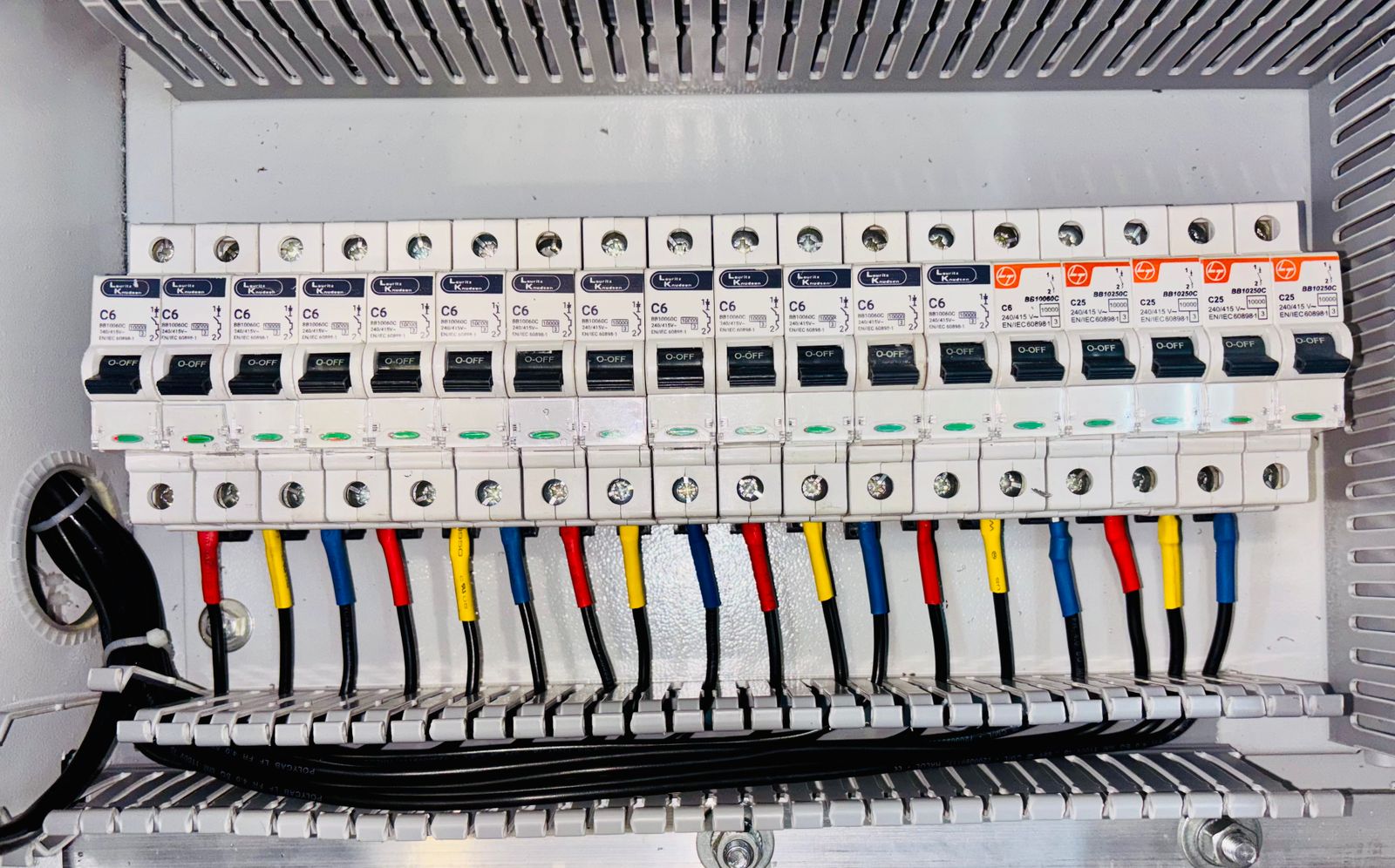
Applicable to miniature circuit breaker (MCB) housings and bases, molded case circuit breaker structural components, contactor and relay housings, and insulating supports inside distribution boxes. These parts operate in energized, heated environments over long periods and must withstand impact during interruption, requiring material rigidity, creep resistance, dimensional stability, and flame-retardant safety.
Production problem
Common pain points in the low-voltage electrical industry include: housings requiring high rigidity and creep resistance to avoid deformation under prolonged heat and load, which would otherwise affect mechanism operation and assembly precision; compliance with electrical safety standards such as flame retardancy and glow wire; glass-fiber reinforcement often causing fiber float and warpage, affecting appearance and assembly; and high product variety with large batch volumes, demanding consistent material quality and reliable delivery schedules.
Modification solution
Recommended primary choice for housings and structural components: [PA66 natural color, glass-fiber reinforced, flame-retardant]. Glass-fiber reinforcement enhances rigidity and dimensional stability; PA66 base resin offers good heat resistance; UL94 V-0 is a common flame-retardant target, configurable as needed; natural color facilitates color matching. For dark-colored parts or components requiring a red phosphorus flame-retardant system, [PA66 red A3X2G5] or [PA6 black, red phosphorus flame-retardant, glass-fiber reinforced] can be used as alternatives, with the latter offering more cost flexibility. Final selection must consider part operating temperature, electrical requirements, and certification status, and be confirmed through trial molding results.
Result
A combined solution centered on glass-fiber reinforced flame-retardant PA66, supplemented by red phosphorus flame-retardant grades, covers multiple part types in circuit breakers, helping customers reduce material variety and stabilize assembly precision; a clear flame-retardant route facilitates product safety certification; stable batch supply makes production scheduling more controllable.
How we worked
- Part breakdown: Define rigidity, heat resistance, flame retardancy, and appearance requirements for housings, bases, and internal components separately.
- Solution combination: Use PA66 natural color, glass-fiber reinforced, flame-retardant as the primary choice; add A3X2G5 or PA6 red phosphorus flame-retardant glass-fiber reinforced as needed.
- Trial molding optimization: Support trial molding, monitor warpage, fiber float, and dimensions, and assist in optimizing drying and injection molding parameters.
- Mass production delivery: Lock the solution and supply consistently in batch, with ongoing follow-up on lot-to-lot consistency.
| Item | Before | After |
|---|---|---|
| Flame-retardant direction | UL94 V-0 target, configurable as needed | |
| Reinforcement method | Glass-fiber reinforced | |
| Recommended materials | PA66 natural color glass-fiber reinforced flame-retardant / PA66 red A3X2G5 / PA6 black red phosphorus flame-retardant glass-fiber reinforced | |
| Key focus areas | Rigidity, creep resistance, dimensional stability |
Service
Assist customers in defining the performance priorities for housings, bases, and internal components, and provide material combination recommendations per part; supply sample materials and support trial molding, offering process adjustment suggestions for issues such as fiber float and warpage; after validation, supply in batch production with consistent lot-to-lot quality to facilitate customer production scheduling.