Customer need
Fasteners such as cable ties and plastic expansion anchors (wall plugs) are often shipped to northern regions, where they are used outdoors at temperatures below -10°C in winter for installing air conditioners and piping, as well as in cold storage facilities. What customers need is simple: cable ties must not break when tightened in winter, and expansion anchors must not crack when hammered into walls.
Production problem
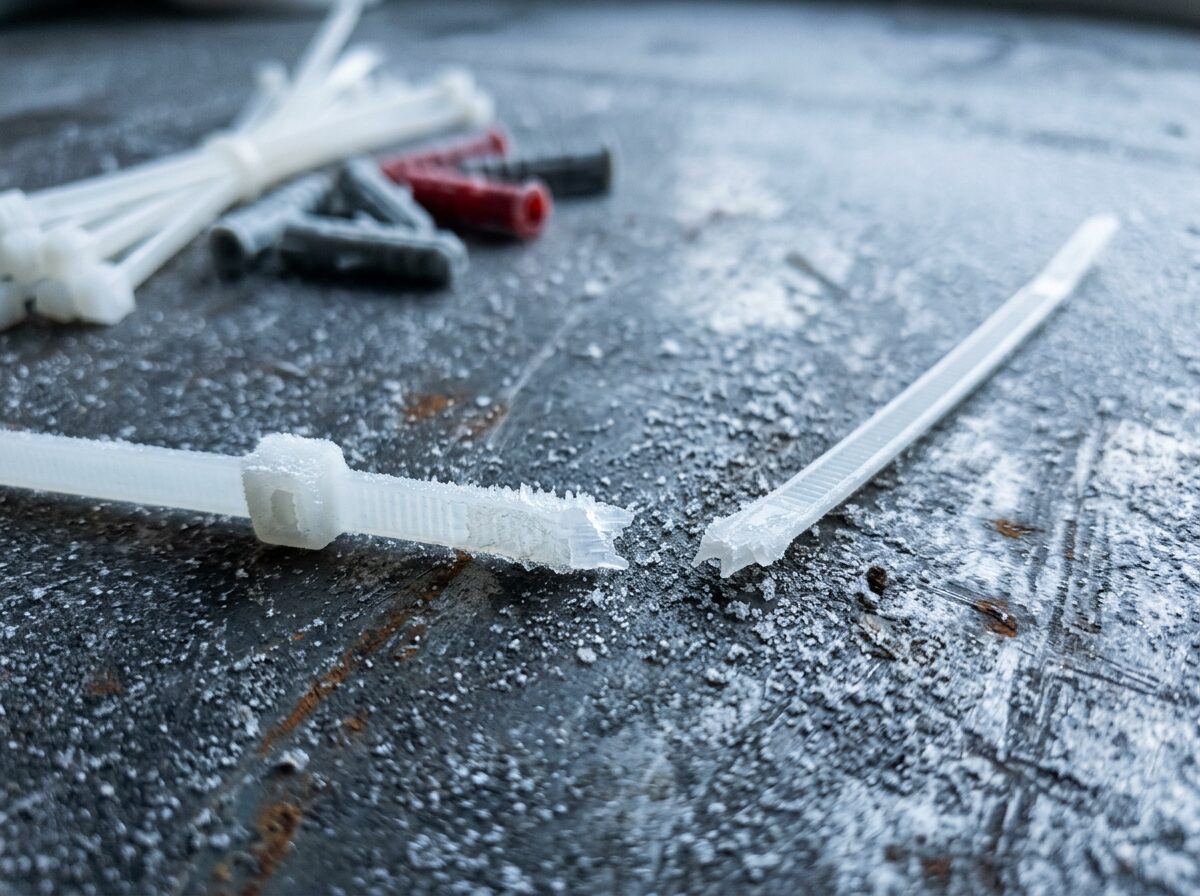
With the same batch of material and the same mold, there were almost no complaints in summer. But returns started to rise in November: cable ties snapped with a 'pop' at the base of the locking head when tightened, and expansion anchors split into several pieces at the tail end halfway through hammering. Another telling sign: freshly molded parts were more brittle than those that had been stored for a few days, and inventory stored in a northern warehouse for a whole winter broke more easily than newly arrived stock.
First, examine the fractured parts: the fracture surface is flat and shiny with almost no whitening or drawn fibers—a typical brittle fracture, not a break caused by excessive force. Next, check the material and process: nylon coming straight out of the mold contains almost no moisture and is at its most brittle; in the dry northern winter air, the small amount of moisture in the parts gradually escapes. Dry state plus low temperature together turn nylon from 'tough' to 'brittle'.
Modification solution
Moisture conditioning alone only helps temporarily—parts will dry out again once they reach northern warehouses. So the root cause must be addressed at the material level.
Step 1: Add an elastomer toughening agent with good compatibility with nylon to PA6, along with a compatibilizer to ensure the toughening phase is finely dispersed and firmly bonded to the matrix. If dispersion is poor, the toughening agent becomes nothing more than an 'impurity'—strength drops without any improvement in toughness.
Step 2: The amount of toughening agent must be determined through physical testing: too little and the material remains brittle at low temperatures; too much and cable ties become soft with insufficient locking force, and expansion anchors fail to grip in the wall. Typically, two or three loading levels are tested, molded into cable ties and expansion anchors, frozen in a low-temperature chamber, and then subjected to tightening and hammering tests. The formulation with the fewest failures and acceptable hand-feel is selected.
Step 3: Provide packaging recommendations to the customer: condition the parts after molding, then package them in sealed bags to minimize moisture loss during transportation and storage.
Result
After switching to the toughened material, the same low-temperature chamber tests showed that cable ties no longer snapped at the base of the locking head when tightened, and tail-end cracking of expansion anchors during hammering was significantly reduced. Winter returns of this type essentially disappeared. The customer no longer needs to switch between a summer-grade and a winter-grade material, simplifying inventory management.
How we worked
- Collect fractured parts and examine the fracture surface: determine whether it is brittle fracture or overload-induced breakage
- Check molding and storage conditions: moisture content after molding, packaging method, and shipping destination
- Prepare 2–3 toughening agent loading levels for sample molding, freeze, and conduct tightening and hammering tests
- Finalize the formulation, provide moisture conditioning and sealed packaging recommendations, begin volume supply, and follow up on first-winter field feedback.
| Item | Before | After |
|---|---|---|
| Low-temperature installation | Prone to breaking during tightening and hammering | Retains toughness at low temperatures |
| Seasonal variation | Concentrated winter complaints | Consistent year-round performance |
| Material | Standard PA6 / PA66 | Toughened modified PA6 / PA66 |