Customer need
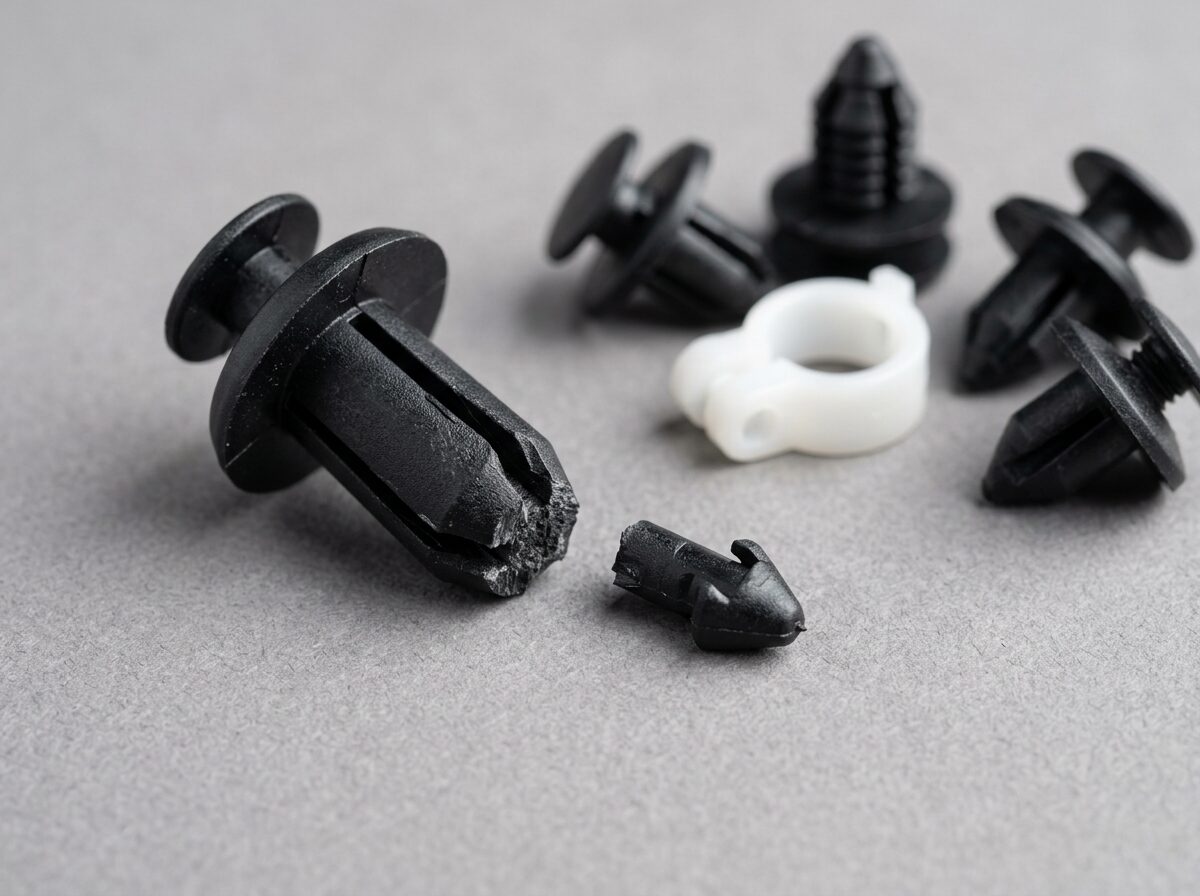
These are high-volume small parts in automobiles: interior trim clips, wire harness retainers, and hose clamps. Workers install them by hand, pressing them directly into holes in sheet metal. The requirement is that they snap into place in one press without breaking the legs; once installed, they must withstand years of vibration and thermal cycling without loosening or rattling.
Production problem
The problem occurred on the assembly line: when the clip was pressed in, the locking leg broke off at its root, and the broken piece fell inside the vehicle body. Breakage was more frequent in winter or when the workshop was dry, and freshly molded parts broke more easily than parts that had been sitting for a while.
The customer had previously tried a "softer" material on their own. The broken legs did become less frequent, but a new problem appeared: the pull-out force was insufficient, leading to loosening and rattling after road testing.
Examining the broken parts, the fractures were concentrated at the right-angle transition at the root of the locking leg—the point of highest stress concentration. The fracture surface was flat with no signs of stretching, indicating brittle fracture. This showed the original material was too "rigid," while the later material was too "soft"—neither matched the geometry of the part.
Modification solution
What a clip needs is "rigidity with toughness": it must flex without breaking when pressed, yet spring back with sufficient force.
We used PA6 as the base resin and selected toughening agents with good compatibility with nylon. We prepared several formulations with increasing toughener content, molding each into actual clips rather than just standard test bars—because good test bar data doesn't guarantee the clip will perform in a sheet metal hole.
For each formulation, we performed three tests: assembly at room temperature, assembly after freezing, and pull-out force measurement after installation. This allowed us to identify the window where the clip assembles without breaking while maintaining adequate pull-out force.
For clips near the engine compartment where temperatures are high, we added heat stabilization to the formulation. For hose clamps requiring higher retention force, we combined a small amount of glass fiber with the toughening system. We also recommended that the customer change the sharp right-angle at the root of the locking leg to a small radius to reduce stress concentration.
Result
The final formulation no longer broke during assembly, could be snapped in place even after freezing, and the pull-out force returned to the required range, resolving the loosening and rattling issues in road tests. The materials were ultimately divided into several grades based on installation location—interior, body, and engine compartment—so a single solution covered the customer's entire family of clips.
How we worked
- Collected broken parts and assembly videos to confirm the fracture location and fracture surface morphology
- Identified stress concentration points by analyzing the part geometry
- Created a gradient of toughener loadings and conducted room-temperature/frozen assembly and pull-out force tests using actual clips
- Finalized formulations by installation location, provided recommendations for adding a radius at the corner, and began volume supply.
| Item | Before | After |
|---|---|---|
| Assembly | Locking leg fractured at root | Snapped in place without breaking |
| Retention Force | Loosened easily after switching to softer material | Balanced rigidity and toughness, no loosening |
| Material | Standard PA6 | Toughened / reinforced & toughened PA6, PA66 |