Customer need
Black housings for power tools such as electric drills and angle grinders. The housing must withstand drops and secure the motor, hence the use of glass-fiber reinforced nylon; however, it is also the first thing consumers see and hold daily, so brands enforce strict appearance standards: a uniform matte black surface, free from whitening or mottling.
Production problem
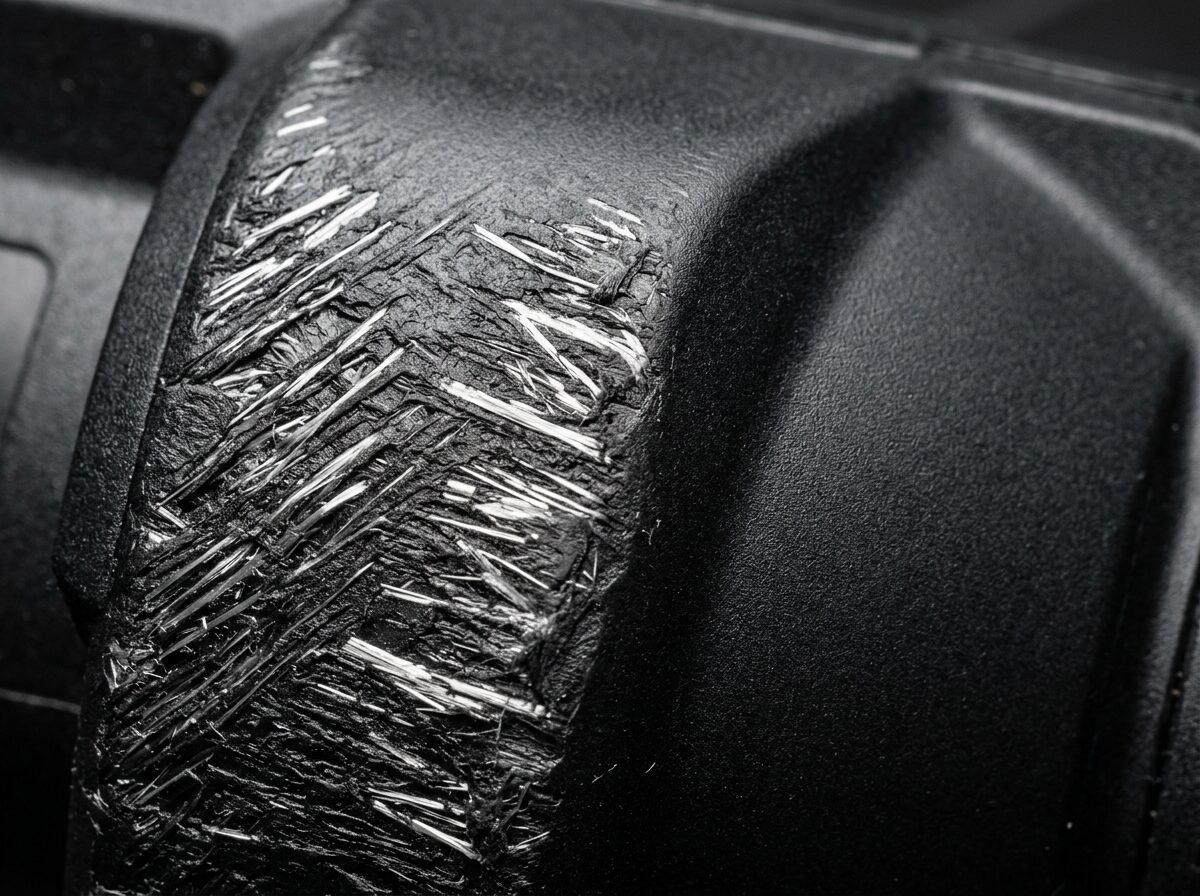
On the injection-molded housings, the area near the gate was acceptable, but quality deteriorated towards the end of the melt flow: silvery-white fiber streaks appeared on the surface, which felt rough to the touch, most prominently at weld lines and corners. Batches were repeatedly rejected during incoming inspection, forcing the factory to sort, rework, or apply a paint coating to hide the defects—all of which strained costs and lead times.
Initial troubleshooting focused on the process: raising the mold temperature reduced fiber float somewhat, but increased cycle time and reduced output, and the issue persisted in the corner farthest from the mold heat. Switching to different material batches in the same mold showed clear differences—indicating the root cause was primarily the material: the glass fibers and nylon weren't bonding tightly enough. As the melt flowed forward, the fibers moved ahead and froze upon contact with the relatively cooler mold surface before the resin could encapsulate them, leaving them exposed.
Modification solution
The approach was to make the glass fibers and resin 'flow together'.
First, we switched to glass fibers with a more compatible coupling agent treatment and added a compatibilizer to the formulation to strengthen the interfacial bonding between the fibers and nylon. We then incorporated an anti-fiber-float additive and an appropriate amount of lubricating dispersant to improve melt flow and better encapsulate the fibers.
For housings with such high appearance requirements, the glass fiber content can also be moderately reduced, compensating for rigidity with mineral fillers—sufficient strength is the goal, not necessarily maximizing fiber content.
After optimizing the material, we fine-tuned the injection molding process with the customer: appropriately increasing mold temperature and injection speed to ensure the cavity fills before the melt surface solidifies.
Result
After switching to the new material, the silvery-white fiber streaks at the end of the melt flow and at weld lines were significantly reduced, becoming largely invisible on the main surfaces. The appearance parts could be assembled and shipped directly, eliminating the need for sorting and painting. Housing strength and drop performance remained within the original requirements, and black color consistency improved across batches.
How we worked
- Collect defective parts, mark the locations of fiber float, and correlate them with the gate and melt flow direction.
- Test different material batches and adjust mold temperature in the same mold to distinguish between material-related and process-related issues.
- Produce samples with the low-fiber-float formulation and provide recommendations for mold temperature and injection speed.
- After passing appearance, strength, and drop tests, commence mass supply; implement batch-to-batch color difference control for the black material.
| Item | Before | After |
|---|---|---|
| Surface Appearance | White fiber streaks, mottled | Uniform and smooth surface |
| Post-Processing | Required rework or painting | Direct molding and shipping |
| Material | Standard glass-fiber PA6 | Low-fiber-float modified glass-fiber PA6 |