Customer need
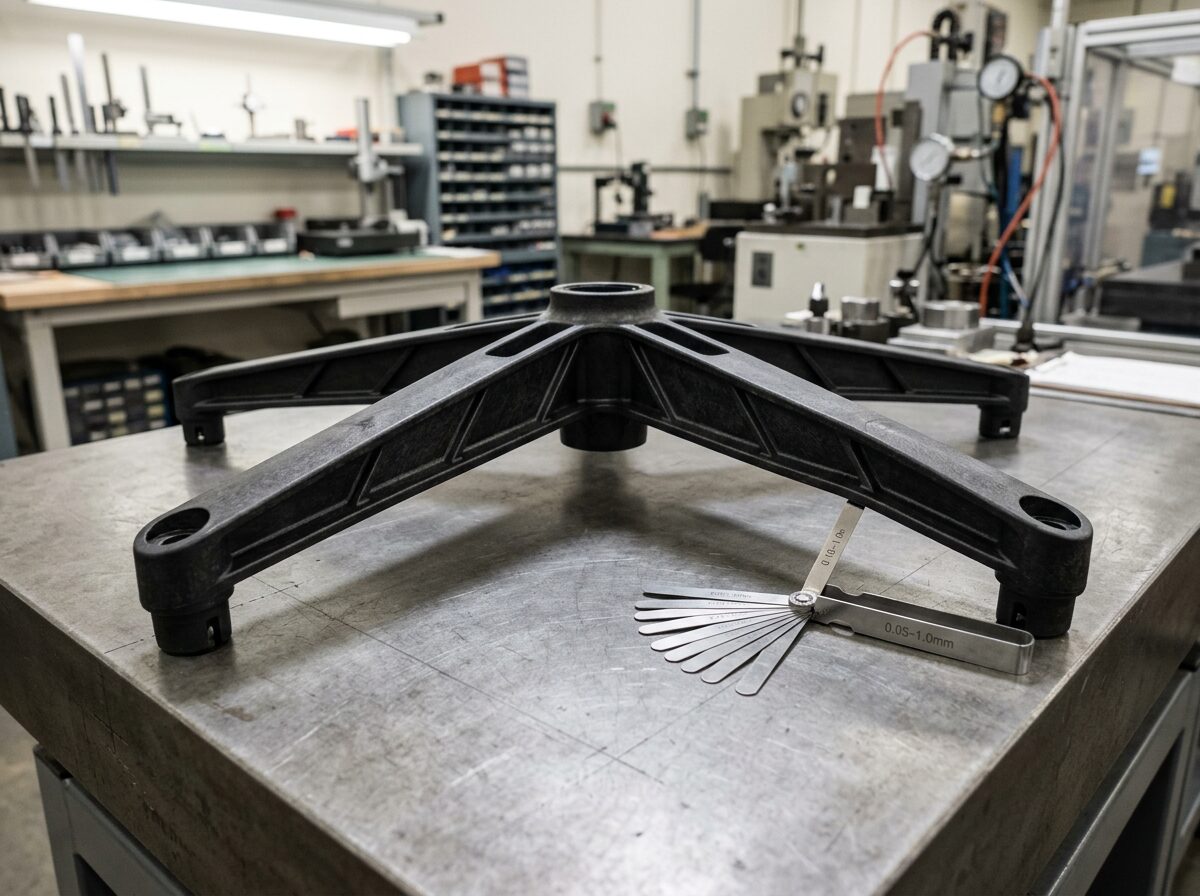
Glass-fiber reinforced nylon large parts such as office chair five-star bases, equipment bases, and large brackets. These parts need to bear loads, so a high amount of glass fiber is added; at the same time, they must sit flat and have accurate hole alignment for subsequent installation of casters, gas lift cylinders, and screws.
Production problem
After demolding and placing the part on the inspection platform, one or two tips of the five-star base were lifted, and a feeler gauge could easily slide underneath. When installing the casters, the holes were misaligned and assembly was difficult. More troublesome was that some parts passed inspection on the day of molding, but after a few days, the deformation measured slightly larger.
First, we investigated the process: holding pressure and cooling time were both adjusted, but improvement was limited. Then we looked at the direction of warpage—it was always related to the direction of material flow. The cause is that glass fibers align in the direction of flow, resulting in low shrinkage along the fiber direction but higher shrinkage in the transverse direction. This differential shrinkage causes large parts to be "twisted" as they cool; uneven wall thickness and uneven cooling amplify the problem, and stress relaxation after storage causes further deformation.
Modification solution
Since adjusting the process alone could not solve the problem, we targeted the material's shrinkage differential.
We compounded plate-like or spherical fillers into the glass-fiber system—plate-like mica, talc, or glass microspheres—which are non-directional and reduce the gap between "low shrinkage along flow" and "high shrinkage transverse to flow." A portion of the glass fiber is retained to maintain strength, rather than removing it entirely.
At the same time, we adjusted the crystallization rate so that the part shrinks more fully in the mold, resulting in less post-mold shrinkage.
Beyond the material, we also worked with the customer to review gate locations and local wall thickness, proposed reducing material in overly thick sections, and made the mold temperature more uniform.
Result
After switching to the low-warpage formulation, the lifting of the five-star base on the platform was significantly reduced, hole alignment consistency improved, and installation of casters and gas lift cylinders became smooth. Re-measurement after several days showed more stable deformation compared to before. Load-bearing performance remained within the original requirements.
How we worked
- Measure defective parts on a platform with a feeler gauge, recording the position and direction of warpage
- Compare gate and material flow direction to distinguish material shrinkage issues from process cooling issues
- Sample a low-warpage formulation with glass fiber + mineral fillers, and adjust mold temperature and holding pressure accordingly
- Proceed to mass supply after dimensional checks, post-storage re-measurement, and load-bearing tests all pass.
| Item | Before | After |
|---|---|---|
| Flatness | One corner lifted, not sitting flat | Significantly improved flatness |
| Assembly | Hole misalignment | Smooth assembly |
| Material | Standard glass-fiber PA6 / PA66 | Low-warpage mineral-compounded glass-fiber nylon |